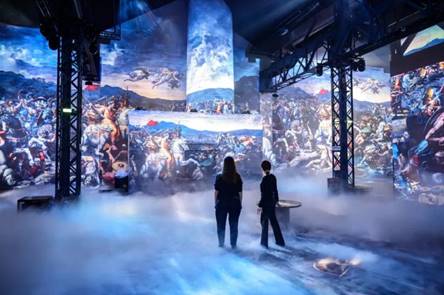

Museums have traditionally relied on artifacts, photographs, documents, and written descriptions to share history and culture. These objects remain essential, but sometimes they cannot communicate the full story on their own. A centuries-old artifact may show what something looked like, for example, but it cannot recreate the environment in which it was used or explain the events surrounding it.
Projection technology gives museums another way to bring these stories to life. Through laser projection, institutions can transform walls, floors, ceilings, and even physical objects into dynamic storytelling surfaces. Instead of simply looking at an exhibit, visitors can experience the setting, context, and ideas behind it. Modern solutions are helping museums create more engaging visual experiences.
1. Bringing Historical Environments Back to Life
A historical object often makes more sense when visitors understand where it came from. Projection can recreate ancient cities, historical buildings, natural landscapes, and everyday environments that no longer exist.
For example, a museum displaying an ancient artifact could project images of its original surroundings onto nearby walls. Visitors can see how the object may have been used and understand its place in a larger historical setting.
This added context makes exhibitions more meaningful without requiring museums to reconstruct entire physical environments.
2. Turning Static Exhibits into Immersive Experiences
Traditional displays encourage visitors to observe objects from a distance. Projection mapping creates opportunities to make exhibition spaces more interactive and visually engaging.
Images can move across architectural surfaces, follow the shape of sculptures, or transform an entire gallery into a themed environment. In some installations, visitors can influence what appears through movement or touch-based interactions.
The technology becomes particularly useful when museums want to communicate complex subjects through visual experiences rather than lengthy explanations.
3. Explaining Stories That Objects Cannot Show
Some subjects are difficult to communicate through physical artifacts alone. Scientific processes, historical events, astronomical discoveries, and environmental changes often involve movement or changes over time.
Projection allows museums to illustrate these concepts through animation and video. A display about space exploration, for instance, can show planetary movement, spacecraft journeys, or the formation of distant galaxies.
These visual explanations can make unfamiliar ideas easier for visitors of different ages and educational backgrounds to understand.
4. Making Exhibitions More Accessible
Not every visitor learns best by reading information panels. Visual storytelling offers another way to communicate important ideas.
Large projected visuals, animations, and carefully designed multimedia presentations can help visitors follow complex narratives. When combined with captions, audio descriptions, and multilingual content, these experiences can support a wider range of accessibility needs.
Museums should still ensure that technology complements traditional interpretation rather than replacing it.
5. Creating Flexible Exhibition Spaces
Museums frequently update exhibitions to attract returning visitors and present new collections. Projection offers flexibility because digital content can be changed without rebuilding an entire physical display.
The same gallery can support different themes, educational programs, or temporary exhibitions through updated visuals and media content.
Final Thoughts
Museum storytelling is evolving beyond objects placed behind glass. Projection technology allows institutions to provide context, recreate environments, and explain ideas in ways that static displays cannot.
When used thoughtfully, it does not replace the artifacts that make museums valuable. It helps visitors understand why those artifacts matter.