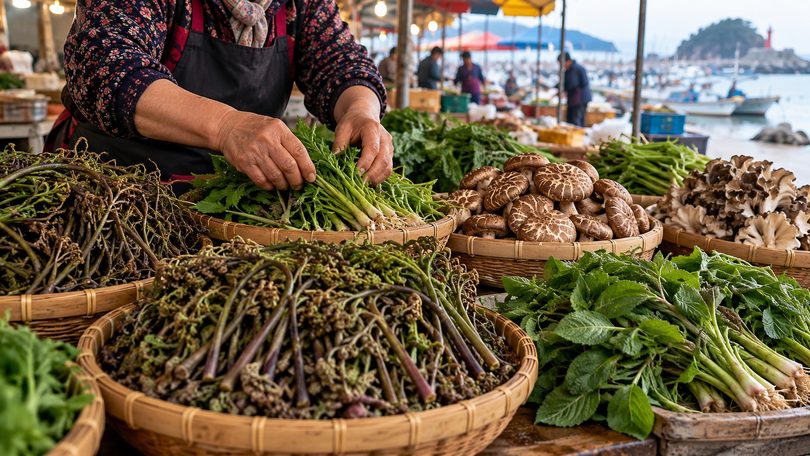

Choose a date ending in four or nine and a trip to Korea’s east coast takes on a different shape. Those are the days when additional traders join the permanent shops at Yangyang Traditional Market. Gangneung, just to the south, has a permanent market of its own. The two make a good pair for anyone curious about what people buy for dinner in a province that has both mountains and sea.
You can visit them in either order. If your dates coincide with Yangyang’s five-day market, give that town the first claim on your morning. On an ordinary trading day, start in Gangneung and decide over lunch how far you want to go. An open afternoon is handy when you have just discovered a soup you want to sit down and eat.
A first lap in Gangneung
Jungang Market spills out of its building into the surrounding alleys. The stretch of downtown alongside it, Wolhwa Street, follows the course of a former railway. Walk a little of that line first. It gives you a landmark you can find again and a sense of where the stalls fit into the rest of the city. Set a meeting point here if your group likes to split up for lunch.
Inside the market, take one lap before buying. You might pass fresh fish on the way in and dried fish on the way out. Look at the quantities on sale. A whole fish, a bundle of smaller fish and a paper box of glazed chicken go home to very different kitchens. At a stall selling dakgangjeong, the sweet-coated fried chicken, ask how big the smallest portion is before ordering. A box to share leaves room for a bowl of something hot.
For a seated meal, look for gamja ongsimi, a Gangwon potato dumpling soup. The appeal is in the chew of the dumplings, quite different from a smooth spoonful of mashed potato. Learn the name of one dish that catches your eye and write it down after lunch. When the same word turns up on a shopfront the next day, a piece of the street suddenly becomes readable.
There is a reason the dumplings hold together so nicely on a spoon. Cooks grate the potatoes, strain them, then mix potato starch into the pulp before shaping it into little balls. A menu that adds the word kalguksu to ongsimi offers another way to taste them. That bowl includes noodles, so you get a strip of soft dough and a chewy dumpling in the same broth.
When the extra stalls come to Yangyang
The fifth-day market gets its name from the interval between trading days. The calendar is easier to remember than the name. The 14th is a market day, for instance, and so is the 19th. There are permanent shops here too. If your train dates are fixed, you can still come on a different day for lunch.
Yangyang’s stalls draw produce from the mountains as well as the coast. In autumn, look for wild mushrooms. Ask the vendor how the mushrooms are sold, especially if you are pointing to a whole basket. Travelers without a kitchen can taste local ingredients in a meal. Sanchae bibimbap brings mountain vegetables together with rice. Another option, dongchimi makguksu, pairs buckwheat noodles with the cool, faintly tart liquid from radish water kimchi.
It is worth distinguishing the foods you can eat there from the ones you can take away. A bowl of noodles needs a seat. A packet of dried ingredients might be a good gift for a friend who cooks. Ask how to prepare it and whether the package should stay cold. If you want a photograph of a stall or its owner, ask while there is a lull in the queue. Keep the aisle clear while you frame it.
What to keep in your phone
Save the market names and your lodging address in Korean before you leave. A screenshot of the entrance is useful for finding the same stall twice. On a two-town trip, label any evening plans by town as well. For visitors considering a massage at their accommodation, 강릉출장마사지 refers to a mobile massage in Gangneung, while 양양출장마사지 is the corresponding term for Yangyang. Check the location, total charge and guesthouse visitor policy before arranging one.
The most interesting entry in that phone note may turn out to be a dish name. Write down what the seller told you to do with the dried mushrooms, or which bowl a friend ordered when you tried the noodles. A market rarely fits into one photograph. It does fit surprisingly well into a few lines you can use the next time you stand in a kitchen and wonder what to cook.